
How to check a gambling website licence and domain
 Available in GB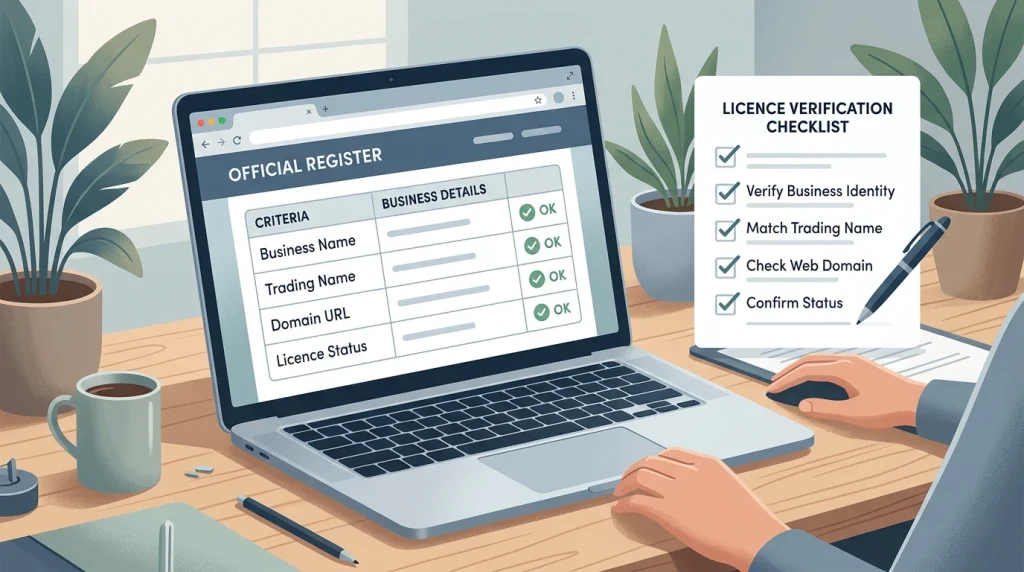
When a gambling website says it is licensed, registered, approved or trusted, the safest first step is not to accept the wording on the page. A licence claim is a factual claim that can often be checked against official records. For Great Britain, the Gambling Commission public register is the main place to check gambling businesses, individuals, regulatory actions and premises. The register can also show useful details such as business status, trading names, domain names and regulatory actions where those details are listed.
This page is about the check itself. It does not decide whether a named website is lawful, it does not rank operators, and it does not turn absence from a register into proof of criminality. It helps you compare a website’s own claims with official information, understand what a mismatch can mean, and decide when to pause instead of relying on advertising language.
The wider picture is in our guide to checks, risks and support.
What a licence check can show
A licence check is most useful when you treat it as a comparison exercise. The website might show a company name, trading name, licence number, regulator logo, registered address or a statement about where it can accept customers. Those details should not be read in isolation. The practical question is whether the same business, the same trading identity and the same domain appear in the official record that the website claims to rely on.
The Gambling Commission public register is designed for this kind of check in Great Britain. A register entry can indicate whether a business appears in the record, what status is shown, what trading names are associated with it, whether domain names are listed, and whether regulatory action information is available. Those points matter because a website may use wording that sounds official while still leaving uncertainty about who is actually operating the site.
A good check starts with the exact details shown by the website. Copy the company name as written, the trading name as written, the website domain without adding your own assumptions, and any licence number that is displayed. Then compare those details against the register. A small spelling difference, a different domain, an old brand name or a missing trading name is not something to brush aside. It may have an innocent explanation, but the burden should not fall on you to guess it.
For UK readers, scope is important. The Gambling Commission regulates gambling in Great Britain. Northern Ireland has a separate legal framework, so a statement about Great Britain should not automatically be stretched to cover the whole UK. If a site uses broad UK language but the record only supports a narrower claim, treat that as a reason to slow down and read carefully.
Step-by-step licence checklist
Use this checklist before creating an account, depositing money or sending documents. It is not a guarantee of safety. It is a way to avoid relying on a claim that does not match official information.
- Start with the website’s own claim. Record the company name, trading name, domain, licence number and any regulator wording exactly as shown. Screenshots can help if the wording changes later.
- Search the official register. Use the Gambling Commission public register when the claim relates to a Great Britain licence. Search by business name and, where possible, check related trading names and domains.
- Compare the domain. The domain you are using should match the listed domain if the register entry provides one. A similar-looking domain is not the same as a match.
- Compare the trading name. A company may use multiple trading names. The name on the gambling site should connect clearly to the register entry, not merely sound similar.
- Check the status shown. Look at whether the entry appears current and whether the status matches what the website implies. Do not rely on a logo alone.
- Look for regulatory action information. If the register shows action or conditions, read the official wording. Do not convert that information into your own legal conclusion, but do consider whether it changes your level of caution.
- Pause on mismatches. If the business, trading name or domain does not line up, do not solve the mismatch by assuming the website is still fine. Ask the operator for a clear explanation in writing, or do not proceed.
- Keep the check separate from payment decisions. Even a matched licence claim does not tell you whether a bonus is fair, whether your payment will be smooth, or whether an identity check will be handled well.
Claim comparison table
| Website claim | What to compare | Safer reading |
|---|---|---|
| “Licensed” or “regulated” | Business name, licence number if shown, register status and scope | Treat it as a claim to verify, not as a trust badge by itself. |
| A regulator logo in the footer | Whether the same operator and domain appear in the relevant official record | A logo is not enough. The official record matters more than the graphic. |
| A familiar trading name | Whether the trading name connects to the licensed business shown on the register | Familiar wording can still hide uncertainty if the business link is unclear. |
| A domain that looks similar to a listed domain | Exact spelling, subdomain, extension and route from the listed record | Near matches are not exact matches. Treat differences as red flags until explained. |
| No obvious Great Britain record | Whether the site is claiming Great Britain licensing or a different jurisdiction | Do not fill the gap with your own assumptions. Scope may be different, or unsupported. |
Limits of the check
A register check is important, but it is not the whole decision. It does not prove that a bonus is suitable, that a withdrawal will be instant, that customer service will be fair, or that the site is appropriate for someone who has self-excluded. It also does not remove the need to read payment terms, privacy information, complaint routes and account verification rules.
Be careful with claims that try to turn lack of a Great Britain record into a selling point. Some pages use phrases around casinos outside GAMSTOP or not on GAMSTOP as if that automatically means more freedom, fewer checks or easier access. That is an unsafe way to read the topic. If you are currently self-excluded, trying to find a route around that protection is a sign to stop and use support rather than looking for another site.
There is also a difference between an official register entry and a personal legal conclusion. A reader can check whether names and domains match. A reader can notice that a record is missing or unclear. But deciding the legal position of a particular site may require facts that are not visible from one page. This guide is not a substitute for legal advice, and it should not be used to accuse a named operator.
When the details do not match
If you find a mismatch, keep the response simple. Do not deposit while the mismatch is unresolved. Do not send identity documents just to “test” whether the account works. Do not accept a live-chat answer that refuses to identify the legal business behind the site. Ask for the business name, trading name, licence details and domain connection in writing. If that still does not make the claim clear, the safest practical choice is to walk away.
When the details do match
A match is useful, but it should not become blind trust. Move to the next checks: payment rules, identity verification, withdrawal conditions, complaint process, customer funds information and privacy settings. A matched licence claim reduces one type of uncertainty. It does not answer every question a user has before sharing money or documents.
With the licence confirmed, move on to payments and identity checks.
Related checks
- Payments, identity checks and withdrawal friction explains why money and document checks need a separate review.
- How complaints and dispute routes work is more useful if a problem has already happened.
- GAMSTOP, self-exclusion and safer choices explains why protection tools should not be treated as obstacles to get around.
If checking a licence claim is part of trying to keep gambling despite self-exclusion, debt pressure or loss of control, pause the search. Support routes such as the National Gambling Helpline, GamCare and GambleAware exist for exactly those moments. Looking for another site is unlikely to solve the underlying risk.