GAMSTOP, self-exclusion and safer choices
 Available in GB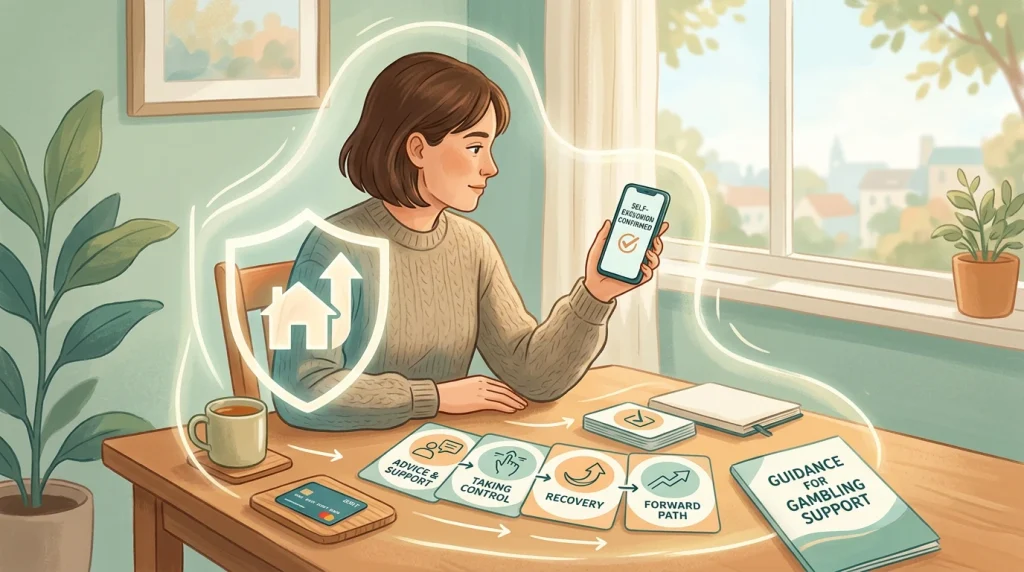
GAMSTOP is an online self-exclusion scheme for people who want to block themselves from gambling with companies licensed in Great Britain. When you sign up, GAMSTOP says it blocks you from signing up or using online accounts with those licensed companies. It also says an exclusion cannot be removed during the selected minimum period. Those points matter because the phrase “casino not on GAMSTOP” is sometimes presented as if it is a convenience feature. If you are self-excluded, it should not be treated that way.
This page explains the protective purpose of GAMSTOP, the safer meaning of bank gambling blocks, and where support can sit in the decision. It does not list websites, describe workarounds, suggest alternative account details, discuss VPN routes, or explain how to get around payment blocks. If you arrived here while trying to continue gambling during an exclusion period, the most useful next step may be support rather than another gambling option.
The wider picture is in our guide to checks, risks and support.
What GAMSTOP does
GAMSTOP is intended to create a barrier between a person and online gambling accounts with companies licensed in Great Britain. The important word is barrier. It is not a mood check, a soft reminder or a setting that should be switched off when temptation returns. GAMSTOP says exclusion cannot be removed during the selected minimum period. That permanence during the chosen period is part of the protection.
The scope also matters. GAMSTOP is connected with companies licensed in Great Britain. It should not be described as if it covers every gambling website in the world, and it should not be described as if anything outside it is automatically acceptable, safe or suitable. A website can be outside a scheme for many reasons, and the fact that it is outside a protection tool does not answer questions about licensing, data, money, terms, support or personal risk.
If a person is not self-excluded and is simply trying to understand a term they have seen online, the safest reading is still cautious. “Not on GAMSTOP” is a description that needs context, not a benefit by itself. It may raise more questions than it answers: Who operates the site? Which regulator is named? What identity checks apply? What complaint route is available? What happens if gambling becomes difficult to control?
How to read “not on GAMSTOP” language
Marketing language around non-participation can be risky because it often focuses on access, speed or fewer barriers. Those are exactly the themes that can be harmful when someone is trying to stop, reduce or control gambling. A page that treats self-exclusion as an inconvenience is not giving you balanced help. It is reframing a protection as an obstacle.
There are several warning signs to notice. Be careful if a page presents exclusion as something to sidestep, suggests that fewer checks are an advantage, implies that payment blocks can be avoided, or makes account creation sound anonymous. Be careful if the page minimises debt, loss chasing, family concern, late-night gambling or repeated attempts to reopen accounts. Those are not small details; they are signals that the decision should slow down.
It is also worth noticing your own reason for reading. If the real reason is curiosity about licensing, use the licence check guide. If the real reason is a payment or withdrawal concern, use the money-check page. If the real reason is that you are self-excluded and want to gamble anyway, a list of alternatives is not the safest answer. The safer answer is to use a barrier, speak to support, and make it harder to act on the urge while it is strongest.
Before trusting any site, confirm it with a licence and domain check.
A safer decision path
| What is happening? | Safer interpretation | Next step |
|---|---|---|
| You are checking a licensing claim | This is a business-identity question, not a reason to ignore protection tools. | Use the official register check and compare the exact business, trading name and domain. |
| You are already self-excluded | The exclusion is there to create distance during a period when gambling may be harmful. | Do not look for ways around it. Use support, bank blocks and practical barriers. |
| You are worried about debt, chasing losses or secrecy | The issue is no longer just about a website; it is about control and harm risk. | Contact gambling support, speak to someone you trust, and avoid opening another account. |
This decision path is deliberately simple because high-pressure moments do not need complicated analysis. When the question is protection, the safer answer is not “which site”. The safer answer is “what barrier helps me not act on this now?”
Bank blocks and support options
Bank gambling blocks are free tools offered by most UK banks to block transactions categorised as gambling. They are not the same as GAMSTOP, but they can sit alongside self-exclusion. Their value is practical: they add friction at the payment stage, which can be important when an urge to gamble is sudden. A block should not be treated as a puzzle to solve. If a block is active, that is useful information about a protection you chose or may need.
If you are considering a bank block, check your own bank’s instructions directly through its app, website or customer support. Do not rely on a gambling website to explain how your bank categorises transactions. Do not test payment methods to see which one gets through. Testing a block can turn a protective step into a new gambling trigger.
Support can be used before things feel severe. The Gambling Commission lists 0808 8020 133 for England and Scotland and 0808 2819 265 for Wales, 24 hours a day, for help and support. GamCare operates the National Gambling Helpline for people affected by gambling harms in Great Britain. GambleAware offers free advice, tools and a service finder for confidential support in Great Britain. These services are not only for a crisis. They can help when you are unsure whether gambling is becoming difficult to control.
Practical barriers that do not involve another site
- Keep GAMSTOP active for the selected minimum period and do not search for ways around it.
- Use bank gambling blocks where your bank offers them, and allow any cooling-off period to do its job.
- Remove saved payment details from devices and wallets where possible.
- Ask a trusted person to help you avoid gambling-related messages or accounts for a while.
- Use support services early, especially if gambling is linked with debt, stress, secrecy or loss chasing.
Related reading
If your question is not about your own self-exclusion, the related pages can help keep the topic in the right lane.
- How to check a gambling website licence and domain focuses on official records and business-identity claims.
- Payments, identity checks and withdrawal friction explains money, document and payment-block issues without block-avoidance advice.
- How complaints and dispute routes work explains evidence and complaint stages when a problem has already happened.
A final check is personal rather than technical. If reading about gambling options makes you feel rushed, secretive, angry about barriers, or convinced you need to win back money, pause. The page you need next is probably not another gambling page. It is a support route, a block, or a conversation with someone who can help you stay away from the next deposit.