
Payments, identity checks and withdrawal friction
 Available in GB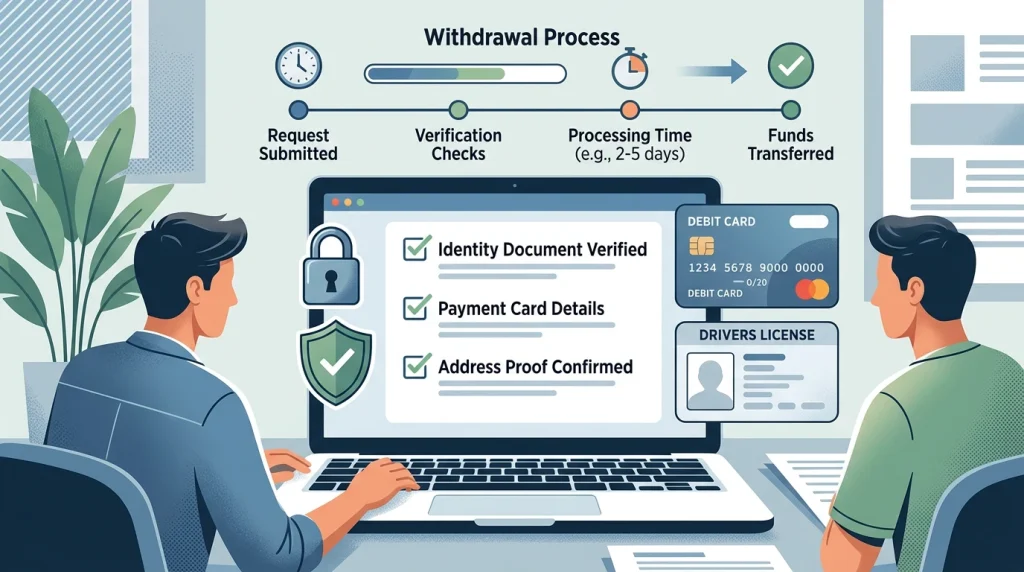
Payment claims can make a gambling website sound simple: quick deposit, fast withdrawal, fewer checks, easier access. Those words need careful reading. Money movement is not separate from licensing, identity verification, customer due diligence, bank blocks or complaint rights. A payment option that looks convenient can still lead to document requests, delayed withdrawals, account questions or a dispute about terms.
This page explains how to read payment and verification claims without assuming a website is safe, available or suitable. It does not list operators, payment methods, payout speeds or ways to avoid bank blocks. It also does not suggest that “no ID” gambling is safe. The aim is to help you notice which claims require a direct check before you deposit money or upload documents.
The wider picture is in our guide to checks, risks and support.
Why payment claims need context
For Great Britain, relevant operators must not accept credit card payments for gambling. That fact is often important when a site says it accepts a broad range of cards or presents payment access as unusually easy. A claim about cards should be checked against the site’s actual scope, the regulator named by the operator, and the payment terms it publishes. Do not treat a payment logo as proof that a method is available, permitted or sensible for you.
Bank gambling blocks add another layer. Most UK banks offer free tools that block transactions categorised as gambling. These blocks are designed to add friction and reduce harm, not to create a challenge for the customer to beat. If you have an active block, or you are thinking about using one, do not test multiple routes to see what slips through. Testing routes can turn a safety tool into a trigger for more gambling.
Payment speed is also easy to overread. “Fast” or “instant” wording may refer to one part of the process, such as a deposit or an internal approval step. It does not always mean money will reach your bank instantly, and it does not remove possible checks. A sensible payment review asks three questions: how money goes in, what checks can happen before or after play, and how money comes out.
Claim-versus-check table
| Claim or situation | Safer interpretation | What to check before acting |
|---|---|---|
| “Credit cards accepted” | This needs careful scope checking because relevant Great Britain operators must not accept credit card payments for gambling. | Check the regulator named, the payment terms and whether the claim is current for your location. |
| “No verification” | This is not automatically a benefit. Online gambling businesses must verify age and identity before gambling in Great Britain. | Read identity, age, account and withdrawal rules before sharing money or documents. |
| “Instant payout” | Speed wording may not include bank processing, checks, unresolved terms or customer due diligence. | Look for withdrawal conditions, document triggers, pending periods and complaint steps. |
| Bank block active or recently added | The block is a protection signal, especially if gambling feels hard to control. | Do not try different routes. Use support or speak to your bank about keeping the block effective. |
| Extra documents requested | Requests can be linked to identity, age, account checks or customer due diligence, but the request should be clear and proportionate. | Ask what is required, why it is required, how it will be handled, and whether the request is tied to a withdrawal or account review. |
Identity and due diligence
Great Britain rules require online gambling businesses to verify age and identity before gambling. That means a claim that suggests easy gambling without meaningful checks should be treated cautiously. Verification is not only a barrier created by one business. It is part of how regulated gambling is expected to work. If a page uses lack of verification as a selling point, ask what protection, accountability and complaint route are being reduced in exchange.
Customer due diligence is another reason a payment or withdrawal may involve questions. Casino operators must apply customer due diligence in defined circumstances, including suspicion, doubts about information, certain thresholds or establishing a business relationship. This page cannot tell you whether a specific request is justified. It can tell you not to assume that every document request is automatically suspicious, and not to assume that every request is automatically fair. The useful middle ground is to ask for a clear explanation and keep records.
Before uploading documents, check the basics. Does the business identity match the licence claim? Does the privacy information explain how personal data and documents are handled? Does the site tell you how to contact support and complain? Are you being asked for documents only after a withdrawal request, despite earlier language implying no checks? None of these points gives a complete answer alone, but together they show whether the process feels transparent or evasive.
Document-safety habits
- Use the official account area rather than sending documents through informal links or social messaging.
- Read what the operator says about data handling before uploading sensitive files.
- Keep copies of requests, timestamps and your replies.
- Do not edit documents to hide required information unless the operator has clearly allowed that type of redaction.
- Do not use another person’s details, payment account or identity to avoid checks.
Withdrawal friction
The Gambling Commission’s public guidance says users can withdraw money without unreasonable delay or restriction. That is a useful principle, but it does not mean every delay is automatically unreasonable. A withdrawal can be affected by open bonus terms, identity checks, payment-route limits, account review or missing information. The practical issue is whether the business explains what is happening and whether the delay is tied to clear published terms or a proper process.
When a withdrawal slows down, collect facts before escalating. Save the withdrawal request, the balance shown, any bonus or wagering status, document requests, chat transcripts and email replies. Record dates. Ask one clear question at a time: what exactly is outstanding, which term or requirement is being relied on, and what happens after you provide the requested information? A vague answer is not proof of wrongdoing, but it is a reason to keep the record tidy.
Do not respond to withdrawal friction by making another deposit or accepting a new bonus. That can make the account position harder to understand. If you are already frustrated, trying to “unlock” a withdrawal by gambling more can increase harm. If the issue involves bonus conditions, use the bonus and withdrawal terms page. If the business does not resolve the issue through its complaint process, the complaints page explains how dispute routes can work.
If a withdrawal stalls, follow how complaints and ADR routes work.
Money-pressure safety note
Payment problems can become stressful quickly. If you are chasing losses, using money needed for bills, trying to bypass a bank block or gambling to fix a withdrawal delay, pause the gambling decision. Support from GamCare, GambleAware or the National Gambling Helpline may be more useful than another payment attempt. A protective block is not a failure; it is a barrier you can use while the urge is strong.
Related pages
- Bonus and withdrawal terms explains how deposit balances, restrictions and evidence can affect money disputes.
- How to check a gambling website licence and domain helps you verify business identity before trusting payment claims.
- GAMSTOP, self-exclusion and safer choices explains why bank blocks and self-exclusion should not be bypassed.
- Privacy, cookies and account security checks covers data and document caution from a privacy angle.