
How complaints and dispute routes work
 Available in GB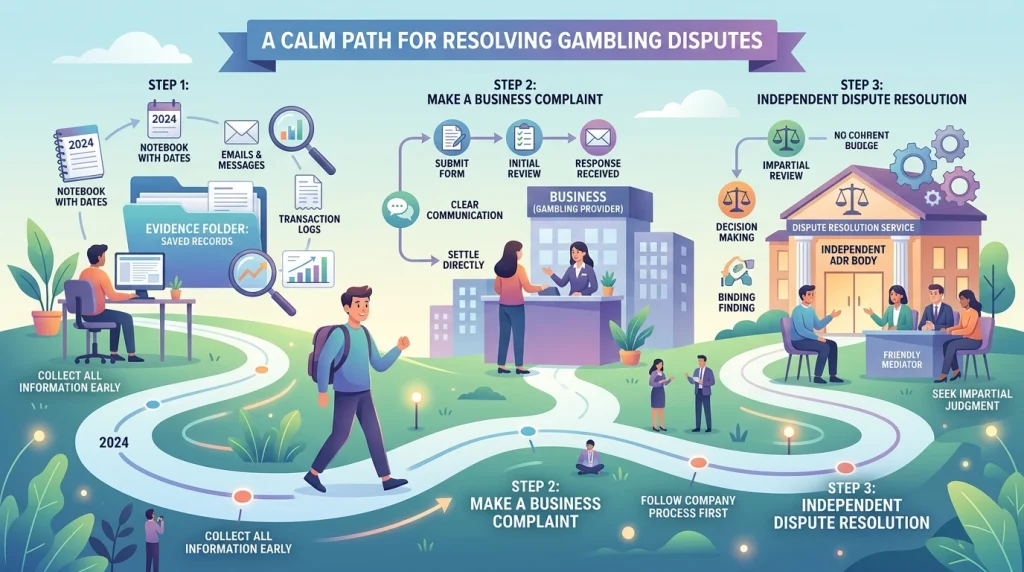
A gambling dispute can feel urgent, especially when it involves a delayed withdrawal, a closed account, a bonus decision, identity checks or poor customer service. The most useful response is not to argue across several channels or assume the outcome in advance. It is to build a clear record, complain to the business in a structured way, and understand when an alternative dispute resolution route may become relevant.
This page explains the route without promising a refund, declaring any operator unlawful or giving legal advice. It is about process and evidence. In Great Britain, official guidance says complaint topics commonly include payments, terms, bonuses, identity verification, account closure and customer service. Official complaint guidance also points users to complain to the business first, and unresolved complaints may move to an approved dispute body after the relevant waiting point.
The wider picture is in our guide to checks, risks and support.
When to make a complaint
A complaint is different from a quick question. A quick question asks for information, such as why a withdrawal is pending or what document is needed. A complaint says that something has gone wrong and asks the business to review it. Moving too early to an angry complaint can make the record messy. Waiting too long can leave you with incomplete dates and missing screenshots. The practical middle ground is to ask once for the reason, save the response, then complain formally if the answer is unclear, inconsistent or does not deal with the issue.
Before you complain, identify the main problem in one sentence. For example: “My withdrawal has been delayed without a clear reason,” “My bonus winnings were removed under a term I cannot find,” or “My account was closed while my balance remains unresolved.” A complaint with one clear problem is easier to handle than a message that mixes every frustration together. You can still include supporting details, but the business should be able to see what decision you want reviewed.
Complaints involving money should be kept separate from arguments about whether you like the site. The useful question is what the terms, messages and account history show. If a withdrawal is delayed, record the date of the request, the amount, any verification request, any stated reason and every update. If the dispute concerns a bonus, keep the promotion wording and the terms that applied when you accepted it. If the issue concerns identity checks, keep the request and note how you submitted the documents.
Most disputes begin with payments and withdrawal friction.
Step-by-step complaint route
- Save your evidence before sending the complaint. Keep the account number or username, dates, transaction references, terms, screenshots and messages. Do not rely on memory if the account later becomes harder to access.
- Use the business’s complaint channel. Look for the complaints process on the site or in the account help area. A formal complaint should be clear, dated and sent through a route you can evidence.
- Describe the issue calmly. State what happened, why you think it is wrong, what evidence supports your view and what outcome you are asking for. Avoid threats or insults because they do not improve the evidence.
- Record every reply and deadline. Save acknowledgement messages, reference numbers, named departments if provided, and dates of promised updates. If a reply sends you back to the same unclear wording, say what remains unanswered.
- Watch the unresolved-complaint point. Official guidance indicates that unresolved complaints may be referred to alternative dispute resolution after 8 weeks where applicable. Do not treat ADR as a shortcut before the business has had the proper opportunity to respond.
- Use an approved dispute route where relevant. If the complaint reaches the appropriate stage, check which ADR body is approved or named for that business. Follow that body’s instructions and keep the same clear timeline.
- Keep expectations realistic. A dispute body can consider certain complaints, but this page cannot promise any result. A strong record improves clarity; it does not guarantee a refund.
Evidence table
| Issue | Evidence to save | What the evidence should show |
|---|---|---|
| Withdrawal delay | Withdrawal request, balance screen, payment messages, verification request and all responses | When the request was made, what reason was given and whether the delay changed over time. |
| Bonus decision | Promotion page, full terms, opt-in date, play or balance messages and decision notice | Which terms were relied on and whether the decision matches the wording available to you. |
| Identity verification | Document request, submission confirmation, account messages and security instructions | What was requested, when it was supplied and whether the business explained any remaining issue. |
| Account closure | Closure notice, balance record, terms cited and customer-service messages | What reason was given and what happened to any remaining balance. |
| Poor customer service | Chat transcripts, emails, message dates and reference numbers | Whether the business answered the specific complaint or only repeated general lines. |
What not to assume
Do not assume that a delay automatically proves wrongdoing. A withdrawal issue may involve identity verification, payment processing, account checks, bonus terms or a genuine complaint. Equally, do not assume that a business can delay indefinitely without explaining what is happening. Official public guidance says users can withdraw money without unreasonable delay or restriction, so the useful complaint question is whether the reason and timing are clear, proportionate and supported by the terms and account record.
Do not threaten legal action, chargebacks or public accusations as a substitute for the complaint process. Those steps may have consequences and this page does not advise on them. A better first record is a concise complaint sent through the correct channel. If the business gives a final response or the complaint remains unresolved at the relevant point, you then have a cleaner record for the next stage.
Do not let the dispute push you into more gambling. Some people continue playing because they are frustrated, trying to recover losses or hoping to unlock a balance. That can make a money problem worse. If the complaint involves unaffordable gambling, chasing losses or distress, pause gambling activity and consider support rather than treating the dispute as a reason to keep depositing.
Writing a clear complaint
A simple structure works well: state the account, the date, the issue, the evidence, the term or message you are relying on, and the outcome you request. For example, you might ask for the withdrawal reason, release of an eligible balance, a written explanation of a bonus decision, or confirmation of what document is still required. Keep the message factual. The person reviewing it should not need to reconstruct your timeline from scattered chat fragments.
When a regulator is not the same as a dispute service
A regulator may publish rules, supervise licensed businesses and provide public information, but that does not mean every individual money dispute is decided directly by the regulator. For many consumer disputes, the practical route is business complaint first and then the relevant ADR route where applicable. This distinction matters because sending the same complaint everywhere at once can slow you down and create confusion about who is meant to answer.
Related checks
- Bonus terms, deposits and withdrawal checks helps you frame a complaint about a promotion or balance restriction.
- How to check a gambling website licence and domain is useful if you are unsure who operates the site.
- Payments, identity checks and withdrawal friction explains checks that may sit behind a delayed withdrawal.
- GAMSTOP, self-exclusion and safer choices is important if the dispute is tied to loss of control, exclusion or pressure to keep gambling.