
Privacy, cookies and account security checks
 Available in GB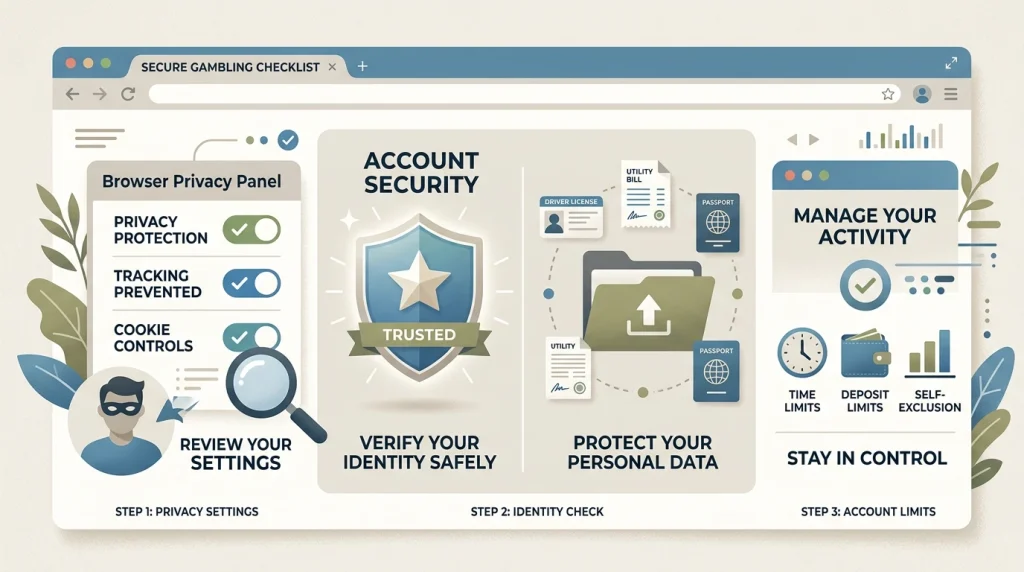
Before you share personal information with a gambling website, the question is not only whether the site looks professional. You are also deciding whether to allow cookies, marketing contact, account tracking, document uploads, payment details and support conversations. This page helps you look at those points calmly. It does not accuse named operators, it does not make legal findings about any site, and it does not suggest hiding your identity from checks.
Privacy and account security are especially important around sites described as outside GAMSTOP or not on GAMSTOP because marketing language can make the experience sound easier than it really is. Easier should not mean less transparent. If a site wants your documents, money, contact details or gambling history, it should also give clear information about who is collecting data, why it is needed, how marketing choices work, and how you can secure your account.
The wider picture is in our guide to checks, risks and support.
Privacy-first checks
Start by identifying the business behind the site. A privacy notice is more useful when it clearly names the organisation, explains what information is collected and gives a practical route for privacy questions. If the page is vague about the legal business, copies wording from somewhere else, or hides important information behind broken links, do not treat that as a small formatting problem. It affects your ability to understand who receives your data.
Next, separate different types of information. Email address and username are not the same as identity documents, payment details, bank statements, device information or gambling history. The more sensitive the information, the higher the need for clarity. A document upload should happen only through a secure account route you trust, not through a random message link or a support channel that cannot be verified.
Then look at choice. Can you reject non-essential cookies before they are placed? Are marketing choices explained clearly? Can you object to direct marketing? ICO guidance on direct marketing stresses transparency about collection and use of information, and includes rights such as objecting to direct marketing. Those rights are not a decorative paragraph. They are practical signals that a business has thought about the customer’s control over data.
Data risk map
| Area | Risk to consider | What to look for |
|---|---|---|
| Cookies and advertising | Tracking may happen before you have made a clear choice. | A clear cookie banner, genuine controls and a readable cookie explanation. |
| Marketing consent | Promotional contact may continue after you no longer want it. | Separate choices for email, SMS or other channels, and a simple route to object. |
| Document upload | Identity documents are sensitive and can be misused if sent through unsafe routes. | Upload only through the official account area after checking the business claim and security signals. |
| Account login | Weak passwords or reused passwords can expose more than one account. | A unique strong password, account recovery you control and caution around shared devices. |
| Support contact | Scammers can imitate support channels or push you into sharing details. | Use contact routes from the signed-in account or verified site pages, not unsolicited links. |
| Unclear operator identity | You may not know who receives your data or who to contact about it. | Check business details and licence claims before sending documents. |
Cookies and marketing
Cookie and advertising controls deserve attention because they shape what happens before you even deposit. The ICO has taken gambling-sector action around advertising cookies being used without consent, which is a reminder that cookie choices are not harmless decoration. A site should not make it easier to accept tracking than to understand it. Look for clear buttons, plain explanations and a way to change your choices later.
Direct marketing is another practical concern. A gambling site may send promotions, reminders, offers or account messages. Some account messages may be necessary, but promotional contact should not be hidden inside confusing wording. Look for who will contact you, which channels may be used, whether third parties are involved, and how to stop marketing. If the only obvious path is to accept everything, that is a caution signal.
Be especially careful if marketing arrives when you are trying to reduce or stop gambling. A message can feel personal and urgent, but it is still marketing. If a promotion encourages you to return after losses, deposit more than planned or gamble while self-excluded, treat privacy settings as only one part of the problem. The safer step may be to block marketing, use account controls and contact support services.
Account security habits
The National Cyber Security Centre’s general online safety advice includes checking legitimacy, limiting shared details, securing accounts and avoiding suspicious links. Those habits apply strongly to gambling accounts because money, identity data and emotionally charged decisions can meet in one place. Do not let urgency override basic checks. If a link asks you to log in, upload documents or confirm payment details, reach the site through your own typed address or saved bookmark instead of the message link.
Use a unique password for gambling accounts and avoid reusing the same password from email, banking or shopping accounts. If multi-factor authentication is available, consider using it. Keep your email account secure too, because account recovery often depends on email access. If you share a device, sign out and avoid saving passwords where another person could access the account. These steps do not prove a site is trustworthy, but they reduce the damage if one part of the chain fails.
Do not solve privacy worries by hiding identity from checks. A regulated operator may need to verify age, identity or other information. Providing false details, opening duplicate accounts or trying to avoid verification can create new problems and may worsen a dispute. The better privacy question is whether the business is clear, secure and proportionate about what it asks for. If that clarity is missing, pause before sharing more.
Before uploading documents
- Check the business and domain claim through the relevant official record where applicable.
- Use only the secure account area or verified upload route.
- Read what type of document is requested and why.
- Save the request and the submission confirmation.
- Do not send documents through social media, unsolicited email links or unverified chat links.
Before sharing documents, verify the operator with a licence check.
When a privacy concern is really a gambling-control concern
Sometimes the concern is not only about data. A person may be looking for a site that appears to ask fewer questions because they are self-excluded, blocked by a bank tool or trying to keep gambling private. That is a different risk. Privacy checks should not become a method for bypassing protection. If gambling feels difficult to control, pause the account search and use support routes rather than looking for a site with fewer visible safeguards.
Related guides
- How to check a gambling website licence and domain helps you confirm the business identity before sharing data.
- Payments, identity checks and withdrawal friction explains why document and payment checks may appear before or after deposits.
- GAMSTOP, self-exclusion and safer choices is important if privacy concerns connect to loss of control or attempts to keep gambling while excluded.